Truly changing sex is possible, says Berkeley trans scholar Grace Lavery
Grace Lavery, an associate professor of English and an expert in trans studies at UC Berkeley, discusses her work in trans feminist studies, her own transition and how allies can help to protect tr…
When Grace Lavery joined UC Berkeley’s English department in 2013, she didn’t know that she would become one of the most followed trans scholars in the world on social media and an outspoken advocate for the trans community.
An associate professor of Victorian literature, Lavery first became interested in trans studies after reading the work of George Eliot, a 19th-century writer — born Mary Ann Evans, who went by a masculine pseudonym.
“There was this thread that I couldn’t stop pulling on,” said Lavery. “We know that Eliot was read as a male writer by many, many people and wanted to be read as a male writer. Those things are interesting and important. It was something that I thought very deeply about.”
After reading several unsatisfactory explanations about why Eliot used a masculine pseudonym, Lavery began to do her own scholarly research on the subject and is now one of Berkeley’s experts on trans studies.
In 2018, Lavery came out as trans at Berkeley — something she felt she had to do in order to give Berkeley her best work. “Being a professor at Berkeley is the best job in the world,” said Lavery. “It’s an incredible honor and gift and privilege to work in such an environment. I had this tremendous sense that I had to figure out how to live, how to be honest with myself.”
Lavery, a member of the Chancellor’s Advisory Committee on the LGBTQ Communities at Cal, edits Transgender Studies Quarterly and writes “The Wazzock’s Review” for the newsletter platform Substack. She is also the author of the book, Please Miss (2022), and is working on her next book, Pleasure and Efficacy: Feminism, Psychoanalysis and Trans Embodiment.
Berkeley News spoke with Lavery, who has been living in Brooklyn, New York, with her partner during the pandemic, about her work in trans feminist studies, the challenges and “life-affirming” surprises that she said she has encountered during her own transition and how allies can help to protect trans rights that are under attack in the U.S.
Berkeley News: Your work in trans feminist studies focuses on the belief that transition works — that it is truly possible to change sex. Can you talk more about what you’ve found in your research? Did you begin to explore the idea during your own transition?
Grace Lavery: I suppose, on some level, I’m bound to cop to that: Research is me-search, as they say. I think what my research has come to demonstrate is that for the past 150 years or so, roughly since the time that people started performing transition or transitioning or whatever you want to call it, there has been this enormous public effort or attempt to produce a cast-iron reason why it doesn’t work or why it is suspicious.There is a kind of conservative feminist position that argues that sex is set in stone, is assigned at birth. And I don’t agree with that. Most scientists I’ve spoken to seem pretty comfortable with the idea that sex, like any other biological category, is not a cast-iron law, but rather a sort of set of contingencies that can be played with and culturally reinforced or not culturally reinforced.
What I’m really interested in is thinking about the ways in which trans people have helped each other to learn better ways to transition, to effectuate the sex changes we are attempting to pursue. And I’m interested in exploring the ways in which people have, in fact, transitioned and lived entirely unprecedented lives, how it entirely and radically shifted their experience of the world.
What are practical tools that you have learned, or are still learning, from other trans people for how to transition better, to effectuate a sex change better?

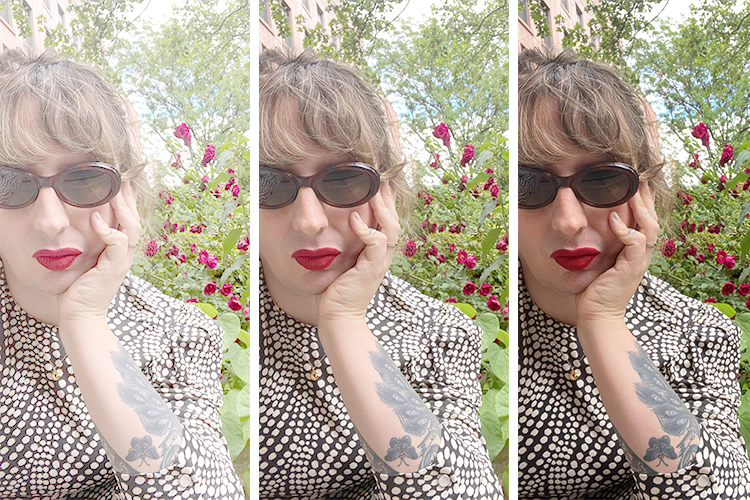
Lavery’s work in trans feminist studies focuses on the belief that transition works — that it is truly possible to change sex. (Photo courtesy of Grace Lavery)
One of the first things that leaps to mind is a disappointing example, which is when I was first beginning to look into how to train my voice. And, you know, it’s actually a place where I feel a great deal of self-consciousness. I feel like my voice is very masculine in a way that my appearance isn’t. When I walk down the street and I get addressed in a gendered way, then I’m more likely to be called ma’am than sir. But on the phone, I’m almost invariably called sir, and so that’s kind of complicated.
One of the things that I encountered in some of the literature when I was beginning to transition was that people would say, “If you want to be treated as a woman, speak less and ask more questions and direct comments more specifically to other individuals.” And I was like, “Well, to me, that feels fairly misogynist, actually” — that I was supposed to make myself smaller, and I’m not really prepared to do that. I do understand how these things work, but that’s not a deal I’m willing to make.
I think there are other things that you can do, which have to do with moving your mouth forward and sort of putting your palate in a particular position. I’m not very good at them. But I would say that my voice has changed in some sort of strange byproduct of some of the other psychosocial dimensions of transition.
Also, early in my transition, I didn’t know what I looked like — what I was trying to look like — so, it was kind of a desperate and confusing time. But I felt like I had to put on makeup. So, you know, I had to learn how to put on eyeliner. I am really grateful that I was living in the East Bay, where a lot of the trans community was really welcoming to me. I made some incredible friends who could answer questions like, “How does one apply eyeliner?” Or, “How does one stop the Sephora lip stain from spilling in your handbag?” Little bits of knowledge that circulate horizontally among women, which trans women need, but don’t always know how to find out.
What has been most surprising to you during your own transition?
What continues to astonish me is that, for me, a hormonal transition and social transition has been an incredibly, unexpectedly pleasure-giving and life-affirming experience. More or less, since I started taking estrogen, I have been happier, so much more at ease with myself and with other people. Something in my chest just changed. Now, I sit differently, I want different things, I speak to people in different ways. I really didn’t think that was going to happen.I would ask people if I seemed like a different person. And from those who knew me well, I would often get the same answer, which is: “You’re like yourself, only more so.”
And so, that’s part of the work, as well — to just let people know that there are things you can do, and they might really make a difference in how you feel about yourself and about the world and your part in it. I don’t think that we know how to talk about the profound effects that hormones have on our ways of engaging and socializing with the world. Certainly, I was not anticipating the overhaul that they would produce in me.
Have you always known that you were trans?
It’s such a complicated question. I ask myself this all the time because there’s this famous expectation that trans women always knew. It does happen. It’s real. But I didn’t always know.
At the age of 11, Lavery was sent to an all-boys school. “I felt alienated by boys,” said Lavery. “I was profoundly afraid of the idea that I might one day grow up to become one of them.” (Photo courtesy of Grace Lavery)
I was born in 1983 and spent the first 14 years of my life in a village called Astwood Bank just outside of a town called Redditch in England. I was raised by my mother and my grandmother. At the age of 11, I was sent to a selective boys school called King Edward’s School. When I think about that, I actually feel more grateful than otherwise, because when I arrived, everyone sort of knew that I wasn’t really supposed to be there.
I felt alienated by boys. I was profoundly afraid of the idea that I might one day grow up to become one of them, hostile to the idea of men and grateful that I didn’t have any men living in the home where I was growing up.
I wish I had known I was trans. The thing is, I never knew the opposite. I often suspected. But I didn’t know any trans people when I was a kid, so I didn’t know that there was anything worth knowing. With a bit of luck, hopefully that’s no longer the case for trans kids.
Where are we today with trans rights in the U.S.? And where do you want to see us in the next five years?
We’re in the midst of a massive backlash against trans civil rights, which is terrifying. We’ve seen bills go through state houses — in Arkansas and Georgia and Iowa — that come darn close to criminalizing the provision of transition-related care, that basically delete an entire field of medicine.I don’t think it’s a coincidence that it’s happening at the same time as the renewed push against abortion, which will, I think, likely lead to the loss of Roe v. Wade and the criminalization of abortion across much of the country. Those are two parts of the same argument. They are a question of what kind of biopolitical control the state can exert over individuals. Can it prevent them from having an abortion? Can it force them to carry children to term? And can it prevent them from changing sex and force upon them unwanted puberty? Those are political questions around which I think feminists need to unite and demand abortion and transition on demand and without apology.
That’s why feminism remains one of the crucial categorical terms in my own research and my own activism. The problem is that it’s precisely that alliance between trans people and feminists that is being most aggressively eroded by the work of conservative feminists who are attempting to sort of expunge trans women, especially from feminist organizations.
So, where do I hope we are in five years? I just hope we’re where we are now. I hope things haven’t gotten any worse. And then, when we have defeated this insurgency of conservative, anti-LGBT, anti-queer, anti-trans, anti-sex feminists — it’s a small contingency within feminism, but enormously influential online, and a lot of them are men — when we defeat that constituency, then we can begin to think about longer-term organizing goals. But our first goal has to be to protect trans kids and protect the right to abortion. Those are the two things that, for me, go hand in hand.
What can allies do to support and protect trans rights and trans communities?
There are plenty of organizations that could very well do with your money. The Sylvia Rivera Law Project (a collective organization that works to guarantee that all people are free to determine their own gender identity and expression) is a really, really important one. But I think, also, a great thing to do is to find trans women in your community who are looking for help with shelter and surgery, and then try to defray their costs by contributing to their GoFundMe campaigns.In terms of one’s labor and one’s energies, find where trans people are in your community and make friends with them. Just make sure that you are doing everything to affirm everyone in your life, to affirm self-orientation and self-determination of gender. It just seems like it’s one of the few political battles where the fight is between a version of total control and a version of total freedom.