Also Phillip the 4th got sick of them and accused them of "Baphomet worship" (one of the only things I think they didn't actually do).
It's more likely true than not. Baphomet is likely to be an allegory of the Gnostic Sophia and an alchemical allegory of transformation into gold - or the Freemasonic order from chaos. Baphe Metis translates to Baptism of Wisdom, an obvious nod to the Gnostic Sophia. The initiation and worship are all Gnostic. Templar shill Eliphas Levi mentioned the as above/so below sign to being an alchemic allegory of Solve and Coagulate (dissolve and coagulate), to dissolve and transform, i.e., the alchemic gold transmutation and symbolic resurrection like Jesus and Osiris, thus the symbolic death and resurrection initiation in Freemasonry.
Another Templar saint, Saint George, has a similar meaning. His defeat of the dragon represents man conquering or taming earth for her wisdom. George represents the solar hero - like Theseus or Marduk - and the alchemic sulfur is represented by the Templar red cross. The dragon represents the earthly beast, the nigredo stage. George overcomes this hurdle to obtain wisdom by acquiring the dragon's head, which could be linked to Baphomet's head or John the Baptist's head (patron saint of Freemasonry), who himself is another wild beast earthly figure, associated with chaotic chthonic beings like Dionysus or the stereotypical deceptions of Satan as a goat like satyr, a half-man/half-animal being. This could be interpreted as a financial allegory on how to create gold/wealth/order/interest in the hero/bank/banker from chaos (debts/chaotic market/profane masses). The white in the Templar flag represents albedo, and the red represents rubedo. The name George has an original root meaning that translates to "earthly worker," which can be linked to the Green Man or the Islamic "Al-Khadir," who just so happens to be one of the few saints both Christians and Muslims venerate and a Crusader saint. George could be used as a symbolic gesture for trade in the Middle East since other Muslims could be potential initiates, linking both Abrahamic religions together in brotherly spirit. George is associated with the Perseus constellation, who conquers the Draco-Dragon-Medusa constellation, saving the Virgo-Princess constellation, which comes in to replace Draco as the pole star. This is what gives these symbols "power," so to speak, or energy from the stars, specifically the magnetic pole star.
The Templar adjacent Italian Genoese revere him as a founding father of sorts, using him in a similar way to how Venice venerates Saint Mark as a founding figure. George is also the patron of England, who allegedly took George from the Genoese since the pirates, specifically Muslim pirates at the time, "feared" the symbol - though we know they really mean revered and respected, since the Muslim pirates themselves worked with Templar pirates. The first proper bank in Europe was created by the Genoese as the Bank of Saint George, and the founding patrons of the financial behemoths of England, Genoa, and Athens all go back to this archetype.

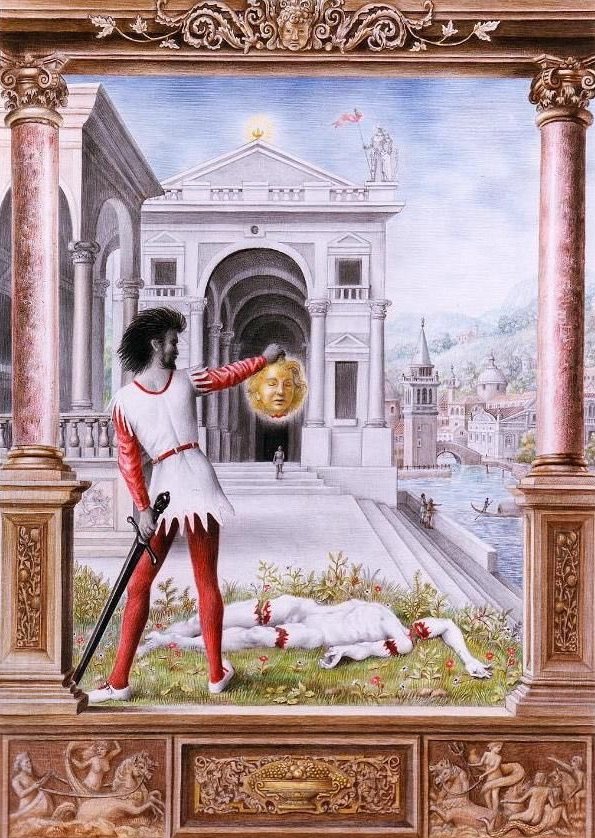

To dissolve and coagulate. The initiate hero holds the golden head of the sacrificed king/master - Osiris/Jesus/Baphomet/John - Osiris had his body chopped into pieces but was later put together by his sister/lover Isis and resurrected.

The triumph of George showing the head of the dragon on his wedding day, or is it his alchemic wedding?

All red sulfuric George


Horus conquers Seth, who is depicted as a crocodile, which is an allegory for chaotic nature. Alchemy has its origins in Egypt, brought to the Occident by Jews and Muslims through initiatic orders. Alchemy is considered to be a sacred science, meaning the mixture of religious spirituality and science.

Earthly Baphomitic John and Solar Sun Hero George stand in juxtaposition like the Freemasonic Jachin and Boaz in between the sacrificial king and his virgin mother, Stella Maris, while Cupid hovers above, which could allude to the Freudian son/king sleeping with his mother motif that is typical in general mythology. Jesus sleeping with Mary Magdalene is a popular Gnostic take, as Magdalene could be interpreted to be another aspect of his mother, representing her shadow and Jesus as the unmovable pole (the unmoved mover) kingly figure, bound to eternal resurrection. All of this is symbolic of Solomon's temple.


