I cannot get the actual paper only, a summary of it.
https://doi.org/10.5210/spir.v2024i0.14071
edit: it appears the research of part of it was already uploaded to k-farms here: https://kiwifarms.st/attachments/van-schenck-replatformization-pptx-pdf.6689170/
https://doi.org/10.5210/spir.v2024i0.14071
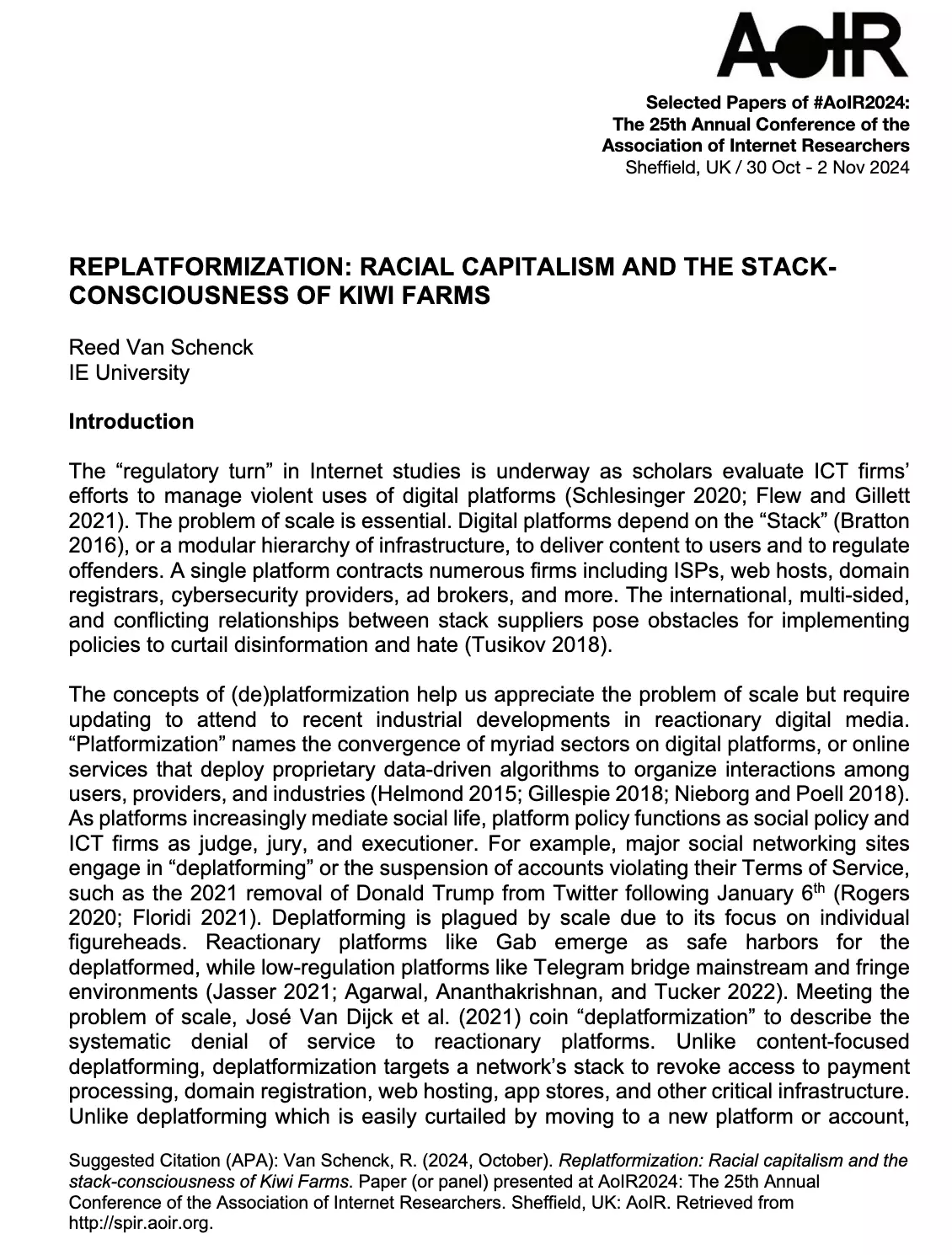
Selected Papers of #AoIR2024: The 25thAnnual Conference of the Association of Internet ResearchersSheffield, UK/ 30 Oct -2Nov 2024Suggested Citation (APA): Van Schenck, R. (2024, October). Replatformization: Racial capitalism and the stack-consciousness of Kiwi Farms. Paper (or panel) presented at AoIR2024: The 25thAnnual Conference of the Association of Internet Researchers. Sheffield, UK: AoIR. Retrieved from http://spir.aoir.org.replatformization: RACIAL CAPITALISM AND THE STACK-CONSCIOUSNESS OF KIWI FARMSReed Van SchenckIE UniversityIntroductionThe “regulatory turn”in Internet studies is underwayas scholars evaluate ICT firms’ effortsto manage violent uses of digital platforms (Schlesinger 2020; Flew and Gillett 2021). The problem of scale is essential.Digital platforms depend on the“Stack” (Bratton 2016), or a modular hierarchy of infrastructure, to deliver content to users and to regulate offenders. A single platform contractsnumerous firms includingISPs,web hosts, domain registrars, cybersecurity providers, ad brokers, and more. The international, multi-sided, and conflicting relationships between stack suppliers pose obstacles for implementing policiesto curtail disinformation and hate (Tusikov 2018).The concepts of (de)platformization help us appreciate the problem of scale but require updating to attend to recent industrial developments in reactionarydigital media. “Platformization”names the convergence of myriad sectorsondigital platforms, or online services thatdeploy proprietary data-driven algorithms to organizeinteractions among users, providers, and industries(Helmond 2015; Gillespie 2018; Nieborg and Poell 2018).As platforms increasingly mediate social life,platform policy functions as social policyand ICT firms as judge, jury, and executioner.For example, major social networking sites engage in “deplatforming” or the suspension of accounts violating their Terms of Service, such as the 2021 removal of Donald Trump from Twitter following January 6th(Rogers 2020; Floridi 2021). Deplatforming is plagued by scale due to its focus on individual figureheads. Reactionary platformslikeGab emerge as safe harbors for the deplatformed, while low-regulation platforms like Telegram bridge mainstream and fringe environments (Jasser 2021; Agarwal, Ananthakrishnan, and Tucker 2022).Meeting the problem of scale, José Van Dijcket al. (2021)coin “deplatformization” to describe the systematic denial of service to reactionary platforms.Unlike content-focused deplatforming, deplatformization targets a network’s stack to revoke access to payment processing, domain registration, web hosting, app stores, and other critical infrastructure. Unlike deplatforming which is easily curtailed by moving to a new platform or account,
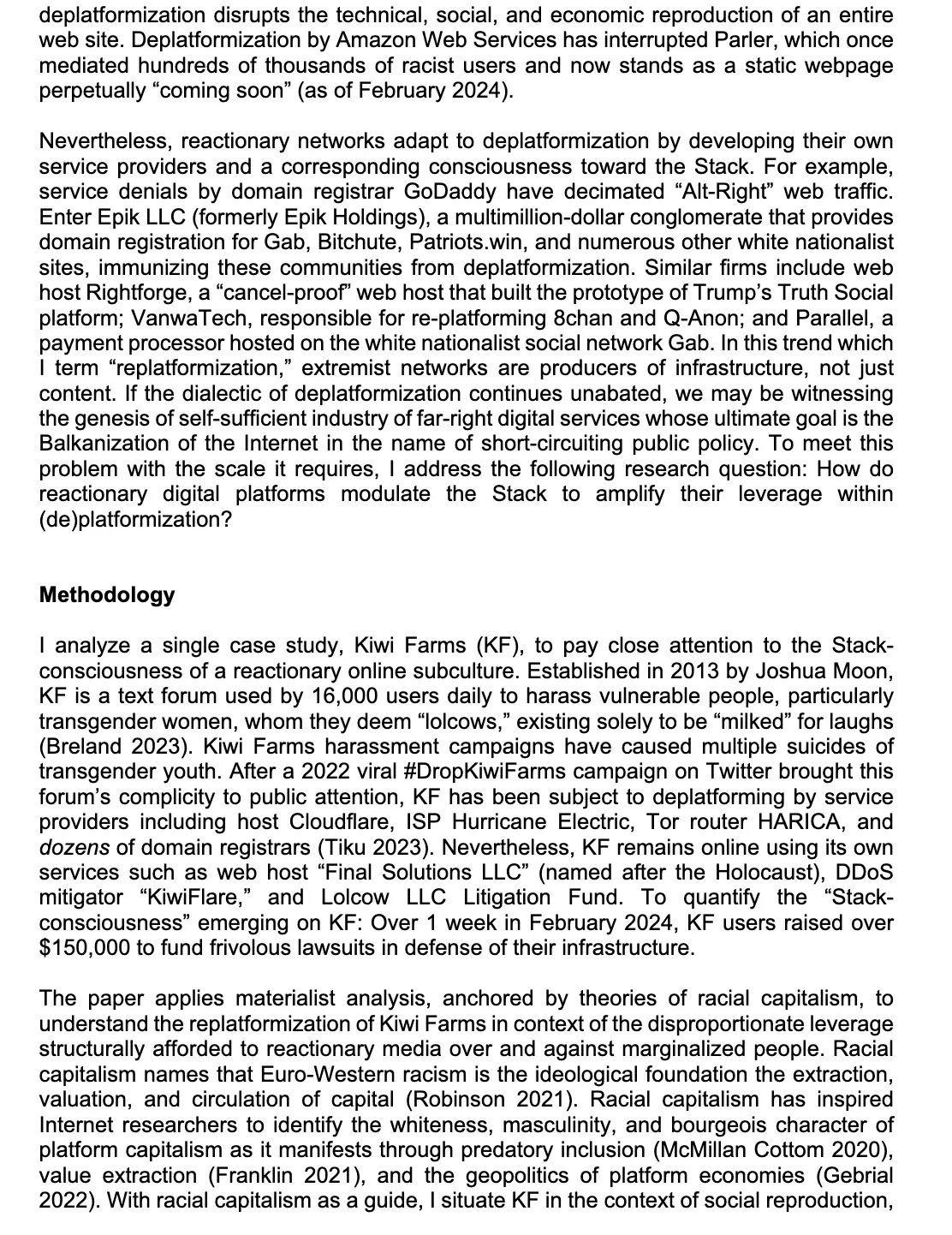
deplatformization disrupts the technical, social, and economic reproduction of an entire web site. Deplatformization by Amazon Web Services has interrupted Parler, which once mediatedhundreds of thousands of racist users and now stands as a static webpage perpetually “coming soon” (as of February 2024). Nevertheless, reactionarynetworks adaptto deplatformization by developing their own service providersand a corresponding consciousness toward the Stack. For example, service denials bydomain registrarGoDaddy have decimated “Alt-Right” web traffic. Enter Epik LLC (formerly Epik Holdings), a multimillion-dollar conglomerate that provides domain registration for Gab, Bitchute, Patriots.win, and numerous other white nationalist sites, immunizing these communities from deplatformization. Similar firms include web host Rightforge,a “cancel-proof” web hostthat builtthe prototype of Trump’s Truth Social platform;VanwaTech, responsible for re-platforming8chan andQ-Anon; and Parallel, a payment processor hosted on the white nationalist social network Gab.In this trend which I term “replatformization,”extremist networks are producers of infrastructure, not just content.If the dialectic of deplatformization continues unabated, we may be witnessing the genesis of self-sufficient industry of far-right digital services whose ultimate goal is the Balkanization of the Internet in the name of short-circuiting public policy. To meet this problem with the scale it requires, I address the following research question: How do reactionary digital platforms modulatethe Stack to amplify their leverage within (de)platformization?MethodologyI analyze a single case study, Kiwi Farms(KF), to pay close attention to the Stack-consciousness of a reactionary online subculture. Established in 2013by Joshua Moon, KFis atextforum used by 16,000 users daily to harass vulnerable people, particularly transgenderwomen, whom they deem “lolcows,” existing solely to be “milked”for laughs(Breland 2023). Kiwi Farms harassment campaignshave causedmultiple suicides of transgender youth. Aftera 2022 viral #DropKiwiFarms campaignon Twitter brought this forum’s complicity to public attention, KFhas been subject to deplatforming by service providers including host Cloudflare, ISP Hurricane Electric, TorrouterHARICA, and dozensof domain registrars(Tiku 2023). Nevertheless, KFremains online using its own services such as web host “Final Solutions LLC” (named after the Holocaust), DDoS mitigator “KiwiFlare,” and Lolcow LLC Litigation Fund.To quantify the “Stack-consciousness” emerging on KF: Over 1 week in February 2024, KFusers raised over $150,000 to fund frivolous lawsuits in defense of their infrastructure. The paper appliesmaterialist analysis, anchored bytheories of racial capitalism,to understand the replatformization of Kiwi Farms in context of the disproportionate leverage structurallyafforded to reactionary media over and against marginalized people.Racial capitalism names that Euro-Western racism is the ideological foundation the extraction, valuation, and circulation of capital(Robinson 2021).Racial capitalism has inspired Internet researchers toidentify the whiteness, masculinity, and bourgeois character of platform capitalismas it manifests through predatory inclusion (McMillan Cottom 2020), value extraction (Franklin 2021), and the geopolitics of platform economies (Gebrial 2022). With racial capitalism as a guide, I situateKF in the context of social reproduction,
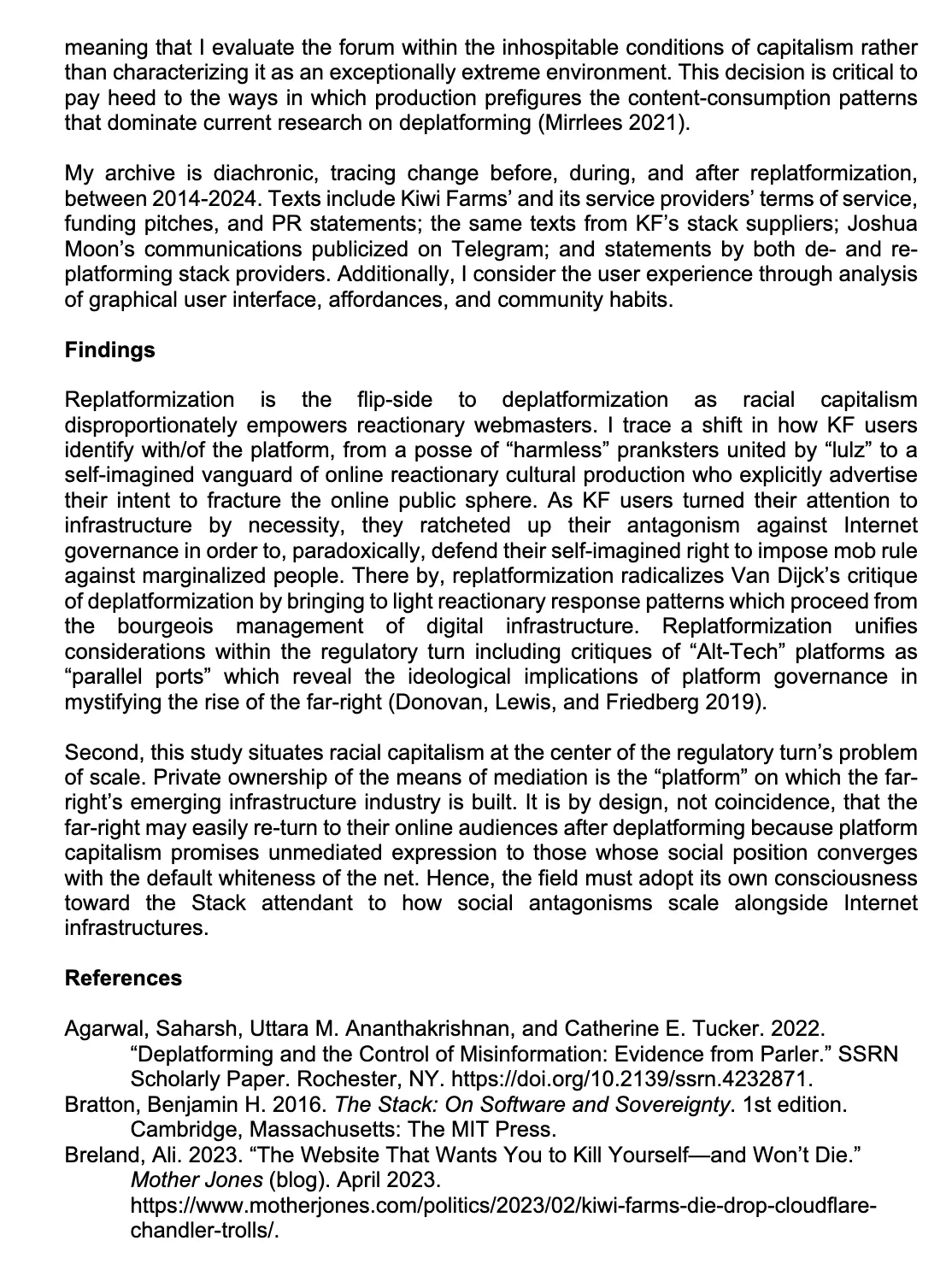
meaning that I evaluate the forum within the inhospitable conditions of capitalism rather than characterizing it as an exceptionally extreme environment. This decision is critical to payheed to the ways in which production prefigures the content-consumption patterns that dominate current research on deplatforming (Mirrlees 2021).My archiveis diachronic, tracing change before, during, and after replatformization, between 2014-2024. Texts include Kiwi Farms’and its service providers’terms of service, funding pitches, and PR statements; the same texts from KF’s stack suppliers; Joshua Moon’s communications publicized on Telegram; and statements by both de-and re-platforming stackproviders. Additionally, I consider the user experience through analysis of graphical user interface, affordances, and community habits.FindingsReplatformization is theflip-side to deplatformization as racial capitalism disproportionately empowers reactionary webmasters.I trace a shift in how KF users identify with/of the platform, from a posse of “harmless” pranksters united by “lulz” to a self-imagined vanguard of online reactionary cultural production who explicitly advertise their intent to fracture the online public sphere. As KF users turned their attentionto infrastructureby necessity, they ratcheted up their antagonism against Internet governance in order to, paradoxically, defend their self-imagined right to impose mob rule against marginalized people. There by, replatformization radicalizes Van Dijck’s critique of deplatformization by bringing to light reactionary response patterns which proceed from the bourgeois management of digital infrastructure.Replatformization unifies considerations within the regulatory turn including critiques of “Alt-Tech” platforms as “parallel ports” which reveal the ideological implications of platform governance in mystifying the rise of the far-right (Donovan, Lewis, and Friedberg 2019).Second, this study situates racial capitalism at the center of the regulatory turn’s problem of scale. Private ownership of the means of mediation is the “platform”on which the far-right’s emerging infrastructure industry is built. It is by design, not coincidence, that the far-rightmay easily re-turn to their online audiences after deplatforming because platform capitalism promises unmediated expression to those whose social position converges with the default whiteness of the net.Hence, the fieldmust adopt its own consciousness toward the Stackattendant to how social antagonisms scale alongside Internet infrastructures. ReferencesAgarwal, Saharsh, Uttara M. Ananthakrishnan, and Catherine E. Tucker. 2022. “Deplatforming and the Control of Misinformation: Evidence from Parler.” SSRN Scholarly Paper. Rochester, NY. https://doi.org/10.2139/ssrn.4232871.Bratton, Benjamin H. 2016. The Stack: On Software and Sovereignty. 1st edition. Cambridge, Massachusetts: The MIT Press.Breland, Ali. 2023. “The Website That Wants You to Kill Yourself—and Won’t Die.” Mother Jones(blog). April 2023. https://www.motherjones.com/politics/2023/02/kiwi-farms-die-drop-cloudflare-chandler-trolls/.
Donovan, Joan, Becca Lewis, and Brian Friedberg. 2019. “Parallel Ports. Sociotechnical Change from the Alt-Right to Alt-Tech.” In Post-Digital Cultures of the Far Right, 49–66. transcript Verlag. https://doi.org/10.1515/9783839446706-004.Flew, Terry, and Rosalie Gillett. 2021. “Platform Policy: Evaluating Different Responses to the Challenges of Platform Power.” Journal of Digital Media & Policy12 (2): 231–46. https://doi.org/10.1386/jdmp_00061_1.Floridi, Luciano. 2021. “Trump, Parler, and Regulating the Infosphere as Our Commons.” Philosophy and Technology34 (1): 1–5. https://doi.org/10.1007/s13347-021-00446-7.Franklin, Seb. 2021. The Digitally Disposed: Racial Capitalism and the Informatics of Value. Minneapolis: U of Minnesota Press.Gebrial, Dalia. 2022. “Racial Platform Capitalism: Empire, Migration and the Making of Uber in London.” Environment and Planning A: Economy and Space, August, 0308518X221115439. https://doi.org/10.1177/0308518X221115439.Gillespie, Tarleton. 2018. Custodians of the Internet: Platforms, Content Moderation, and the Hidden Decisions That Shape Social Media. New Haven: Yale University Press.Helmond, Anne. 2015. “The Platformization of the Web: Making Web Data Platform Ready.” Social Media + Society1 (2). https://doi.org/10.1177/2056305115603080.Jasser, Greta. 2021. “Gab as an Imitated Counterpublic.” In Rise of the Far Right: Technologies of Recruitment and Mobilization, edited by Melody Devries, Judith Bessant, and Rob Watts, 193–212. Rowman & Littlefield.McMillan Cottom, Tressie. 2020. “Where Platform Capitalism and Racial Capitalism Meet: The Sociology of Race and Racism in the Digital Society.” Sociology of Race and Ethnicity6 (4): 441–49. https://doi.org/10.1177/2332649220949473.Mirrlees, Tanner. 2021. “‘Resisting’ the Far Right in Racial Capitalism: Sources, Possibilities, and Limits.” In Rise of the Far Right: Technologies of Recruitment and Mobilization, edited by Melody Devries, Judith Bessant, and Rob Watts. Rowman & Littlefield.Nieborg, David B, and Thomas Poell. 2018. “The Platformization of Cultural Production: Theorizing the Contingent Cultural Commodity.” New Media & Society20 (11): 4275–92. https://doi.org/10.1177/1461444818769694.Robinson, Cedric J. 2021. Black Marxism: The Making of the Black Radical Tradition. 3rd Edition. Chapel Hill: University of North Carolina Press.Rogers, Richard. 2020. “Deplatforming: Following Extreme Internet Celebrities to Telegram and Alternative Social Media.” European Journal of Communication35 (3): 213–29. https://doi.org/10.1177/0267323120922066.Schlesinger, Philip. 2020. “After the Post-Public Sphere.” Media, Culture & Society42 (7–8): 1545–63. https://doi.org/10.1177/0163443720948003.Tiku, Nitasha. 2023. “The Endless Battle to Banish the World’s Most Notorious Stalker Website.” The Washington Post. September 3, 2023. https://www.washingtonpost.com/technology/2023/09/03/kiwifarms-website-offline/.Tusikov, Natasha. 2018. “Internet Firms as Global Regulators.” SSRN Scholarly Paper. Rochester, NY. https://doi.org/10.2139/ssrn.3107268.
Van Dijck, José, Tim de Winkel, and Mirko Tobias Schäfer. 2021. “Deplatformization and the Governance of the Platform Ecosystem.” New Media & Society25 (12): 3438–54. https://doi.org/10.1177/14614448211045662.
edit: it appears the research of part of it was already uploaded to k-farms here: https://kiwifarms.st/attachments/van-schenck-replatformization-pptx-pdf.6689170/
Załączniki
Ostatnio edytowane:


