Is national birth rate decline inevitable in an industrialized society?

Breadbassket

True & Honest Fan
kiwifarms.net
Dołączono
22 Lis 2021
Most of the developed world appear to be having problems with maintaining their population lately (outside of importing foreigners who also seem to start having less children after one generation). Do technological advancements make sub-replacement fertility almost impossible to avoid or are there also cultural or social issues that have to do with it?

Map of countries by crude birth rate:
crude birth rate.png

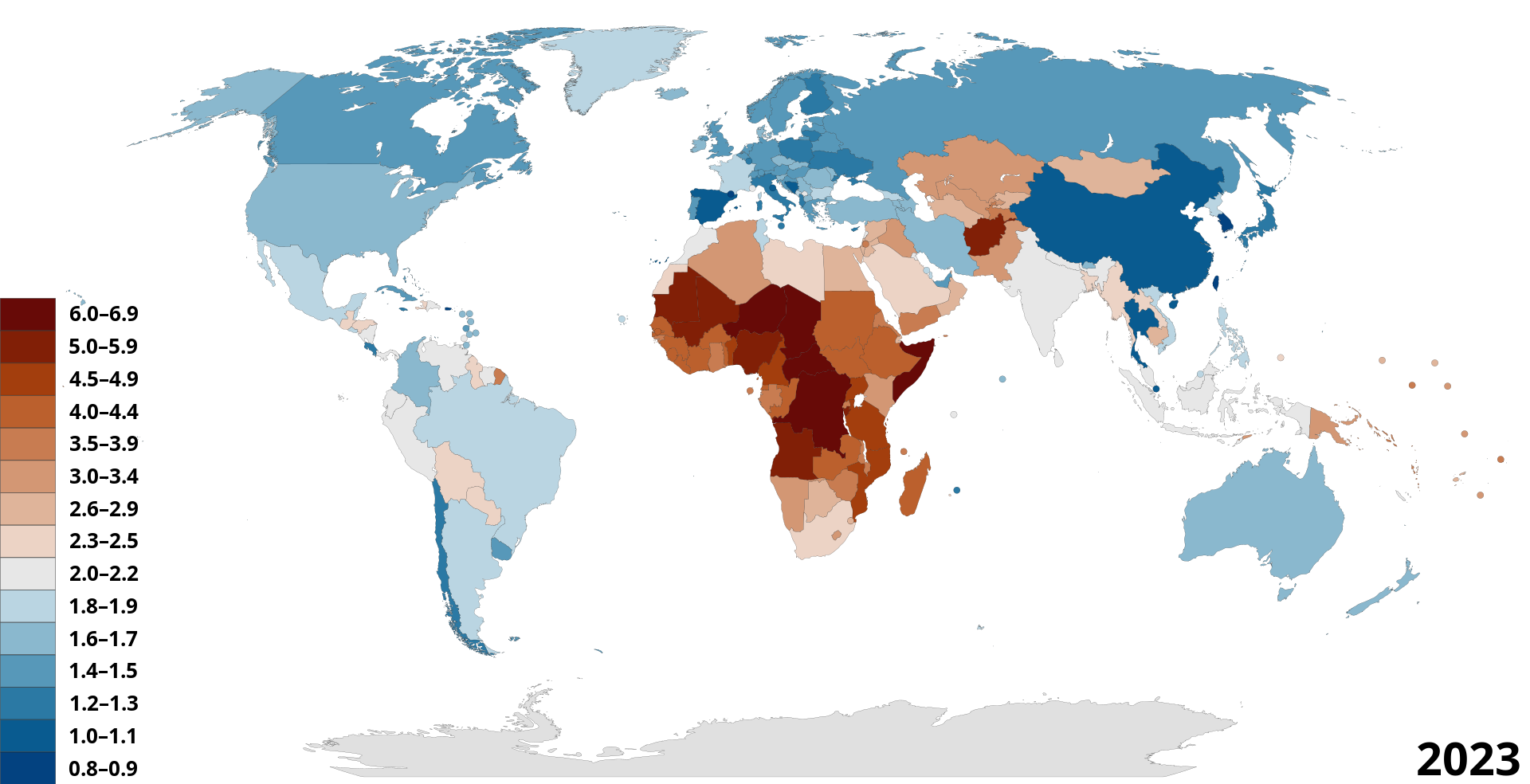
Map of countries by total fertility rate:
fertility.png
 
Ostatnio edytowane:
Do technological advancements make sub-replacement fertility almost impossible to avoid or are there also cultural or social issues that have to do with it?
Iran and USA and turkey are all diametrically opposing and yet every single one of them have bellow 2 tfr. Even the grand MUH BASED LATIN AMERICAN CATHOLIC COUNTRIES are going there with few exceptions . Banning abortion isn't the solution either religion isn't the solution either, culture isn't the solution either all the countries that have above 2 tfr in the current year have low urbanisation rates and low female education rates . Once women come out of their puberty and adolescence with zero pregnancy under their belt the chances of getting pregnant and having more than 2 kids dramatically falls.

Also look at Spengler on declining civilizations who have collapsing birth rates before the final thump. Have you considered that the much of the world is under the thumb of USA empire? I know my home country and the country i live in de facto is a USA vasal state and put in USA laws that make no sense to have .

Have you considered that the world civilization and its rulers are in decline.
 
Wherever women are made more comfortable than men, wherever they get smartphones and wherever they are worshiped by the state the birth rates immediately decline below replacement.

Women control access to sex and reproduction, period. Unless rape is legalized it's best to take it up with them because ultimately most men are losers and will fuck and breed with anyone. All of these studies avoid these truths and point to the most vague minutia for fear of offending women.
 
Industrialization is not the problem.
The service sector economy is. Unless the service is a form of maintenance, it does not contribute to the storing of wealth.
 
this is not an industrialism problem.
this is a feminism problem.

if you allow childlessness to be a viable lifestyle choice for women, enough of them will make that choice to set your society on the path of decline, towards extinction.
if you want your society to survive, the only way to do it is to not allow women to make that choice at all.
 
Should populations grow forever? If birthrates are declining, that may be more a sign of equilibrium more than anything else. There were about 2 billion people in this world only a century ago.

I think the better way to approach it is not how to replace the people who are leaving the economy, but making a declining native population a nonissue.

Oh no, homes won't have as much demand, better lower real estate prices, oh no, this part of the economy has a labor shortage, better raise wages, oh no, not as many people are buying plastic bullshit, better try something other than entering this oversaturated consoomer market, oh me oh my nobody wants to do this unpleasant and disgusting work, better find a way to automate it. Nah, I'll just import anyone I can and make the worst people in my country shit out eleven kids.

Fucking over your future to achieve arbitrary goals set by the WEF and shareholders makes no sense.
 
Wherever women are made more comfortable than men, wherever they get smartphones and wherever they are worshiped by the state the birth rates immediately decline below replacement.

Women control access to sex and reproduction, period. Unless rape is legalized it's best to take it up with them because ultimately most men are losers and will fuck and breed with anyone. All of these studies avoid these truths and point to the most vague minutia for fear of offending women.
Countries that treat women less with tfr in the trash

Iran : tfr currently 1.77 per woman , and has been bellow the replacement rate since 2000

Chile abortion only allowed when fetus not viable and rape

Tfr 1.54 bellow replacement rate reached in 200s.
Btw abortion was banned with no exceptions in 1990 and the law loosened a bit in 2017. Tfr in 1990 was 2.58

Brazil tfr 1.54 , abortion is punishable with prison both for the pregnant women and the person performing there are three exceptions , rape, danger to mothers life and anecephaly in the fetus. 2005 was the year when tfr reached bellow replacement and stayed there


China just technically banned non medically necessary abortions in their state run hospitals in 2022 before that they had on average 9 million abortions
Births in china in 2022 was 9.46 million birth in china in 2023 is 9.06 million

Poland has banned abortion in the 1990s the only two cases is allowed womens health in danger and the pregnancy is a result of illegal act , or the fetus is deformed
In 2021 they tightened the law where fetus being potato and deformed is not enough. Not just that but the new law killed a woman who was forced to keep the pregnancy because one of the twins was alive not joking

Tfr is 1.38 it reached bellow replacement in 1991 . Btw their births collapsed horribly by 30% in the past 5 years

Portugal has legalised abortion on demand in 2007 with the first 10 weeks with reflection periods and doctors having the right to conscious objections

Tfr when it was legalised 1.35, current tfr 1.40, the year when the tfr went bellow replacement: 1982

Spain In the Organic Law 9/1985 adopted on 5 July 1985, induced abortion was legalized in three cases: serious risk to the physical or mental health of the pregnant woman (therapeutic justification), rape (criminal justification), and malformations or defects, physical or mental, in the fetus (eugenic justification). So banned in 1985.

Legalised in 2010

Tfr when was banned 1.64, tfr when it was legalised 1.37 current tfr 1.23

Belize abortion banned unless rape, health of the mother and deformed potato fetus current tfr as of 2020 is 2 and falling according to some statistics

Abortion in Bolivia is illegal, except in the cases of rape, incest, or to protect the woman's health.
Bolivia tfr 2.57 and falling fast

Abortion in Brunei is legal only when it is done to save a woman's life. In Brunei, a woman who induces her abortion is subject to up to seven years in prison. The penalty for someone who performs an abortion was 10–15 years.[1][2 btw it was changed recently to sharia type of punishments for any person inducing abortion : death by stoning.

Tfr 1.80


Abortion in Costa Rica is severely restricted by criminal law. Currently, abortions are allowed in Costa Rica only in order to preserve the life or physical health of the woman. Abortions are illegal in almost all cases, including when the pregnancy is a result of rape or incest and when the foetus suffers from medical problems or birth defects

Tfr 1.56 when it droped bellow 2: 2009

Abortion in Cyprus can since 2018 be performed on request up until the 12th week of pregnancy and until the 19th week in rape cases.[1] It was previously performed only if there was a risk of physical or mental harm to the mother, a risk of fetal deformity, or if the patient was raped or otherwise sexually assaulted.[2][3]

While there is no specific guideline limiting when an abortion is permitted under Cypriot law, in practice no abortions are performed after the 28th week.[2] Cyprus has a natalist policy[2] and thus will not provide routine abortion procedures in state hospitals, so they are typically performed in private clinics, with hospitals only providing the procedure if the mother is at great risk.[3] As abortions are paid out of pocket by the woman undergoing the procedure, private practitioners can and have performed abortions outside the legal framework.[2]

Tfr when it was legalised in 2018 : 1.32
Current tfr : 1.33

The Dominican Republic is one of 24 countries in the world and one of six in Latin America that has a complete ban on abortion.[1] This complete ban includes situations in which a pregnant person’s life is at risk.[2

Tfr 2.3 or 1.81 depending which sources you consult and declining their total births peaked in 2000s at 190k birth per year


Abortion in Ecuador is illegal except when performed in the case of a threat to the life or health of a pregnant woman (when this threat cannot be averted by other means) or when the pregnancy is the result of rape, including but not only a sexual crime against a mentally disabled woman where her legal representative has consented to the abortion.[1] In 2021, the Constitutional Court of Ecuador ruled for the decriminalization of abortion in all cases of rape.[2]

The Ministry of Public Health provides guidelines on therapeutic abortion.

In Ecuador, there is strong political opposition to abortion; in 2013 then president Rafael Correa threatened to resign if the abortion law was liberalized.[3] As of 2015, nearly 100 criminal cases of illegal abortion were under investigation.[4]

In 2015, Ecuador was urged by CEDAW to decriminalize abortion in cases of rape and incest (under law abortion at the time it was legal only if the woman is mentally disabled) and severe fetal impairment (which is also illegal).[4]


Tfr 2 or 2.3 depending on which sources you consult but their total number of births have peaked in 2000 at 350k in 2022 was 250k a 100k reduction

Abortion is illegal in El Salvador. The law formerly permitted an abortion to be performed under some limited circumstances, but in 1998 all exceptions were removed when a new abortion law went into effect.[1

Tfr in 1998 3.36 current tfr 1.82 .

Abortion in Guatemala is illegal, except when needed to save the woman's life.[1

Tfr is 2.4 or 2.2 rapidly falling

Abortion in Honduras is completely prohibited under any circumstance, and has been constitutionally prohibited since 1982.[1] The country's constitutional prohibition on abortion was further cemented by the country's Congress on January 22, 2021

Tfr 2.01 or 2.39 depending on the source again rapidly falling and the population piramid is getting more chimney look than piramid


Abortion in Lebanon is criminalised in all cases except for when the mother's life is at risk[1

Tfr 2.01 or 1.79 depending on the source their population pyramid is looking more inverse than anything else


Abortion in Malta is illegal except in cases where the life of the pregnant woman is at risk.[1] Until 2023, it was illegal in all cases.[2

Tfr 1.13 when it hit the trashhold in 1980

I can go on but i think this is demostrative enough that your assumption based on your feelings is trash . Just admit you want women to have no rights to say who they fuck and marital rape to be legal again
 
Sounds like child rearing sucks for women if they'd much prefer not to do it when given any other option. How dare those evil women have the right to choose not to be baby factories.

Boring.
Bull. Shit. Maybe your mother didn't enjoy rearing you, but me and all my girl friends are mothers now and regret not doing it sooner.
Most mums live for their kids with the exception of the millions broken by diddling, daddy running out on them or growing up with a broken woman for a mother themselves.

The low birth rate comes from the monster that is feminism; it both made it very unrespectactable to be a mother (I went to an all girls school who were insistent that the only way we truly failed was to get pregnant young. We'd all laugh and agree because everyone knew those girls were losers and chavs) and got enough women working for anyone BUT her family that we've since not been able to survive on our husband's wage alone.

This isn't necessarily women's fault, most kids are easily cowed when they're young and THAT'S when they hit you with the ideology from every angle; that obviously we're not as good as men until we pretend to be men, this doesn't help women or men but it certainly helps businesses and the powers that be.

Women don't have lots of children because we're built more for survival than exploration, that is to say whilst the males are out we're in charge of keeping the tribe and the children alive, no shit we take less risks for dumb reasons, no shit we go along to get along when things get rough and no shit we won't bear young if we have neither the time or resources to care for that individual given the choice.

Kids are the best thing ever. There's a great Jordan Peterson conversation where he details that many female lawyers, very successful women, were leaving the job in droves once they realized that work wasn't shit when compared to our true calling and the firms couldn't do enough to keep them there, not all the extra diversity money in the world.

You want more women breeding? It's fucking simple: stop guilting little girls into the insane idea that they can do better , collectively treat mothers with the respect that we used to (because you're really selling it to little girls when you whinge about Karen's and talk shit about your own mothers. Who'd want to be that daft cunt, used by everyone for free then ignored and laughed at when they dare complain about something), stop spreading birth horror stories (or at least end them the way I do mine "...and after 3 days labour, an emergency C section and never recovering full mobility in my pelvis, I decided it was all absolutely worth it and I'd do it again. Honestly it can all go wrong and the only thing you'd regret is the very idea of not doing it!") and somehow figure out a way to work where your wife can focus purely on the children.

Stop colloquially making birth the worst possible fate for all women.

Edit: fuck off Catler, you're literally a faggot, wtf do you know about women other than what society at large whispers in your ear.
 
Ostatnio edytowane:
Relating to this discussion, here is an article elaborating on why parts of Africa have such a high birth rate currently and the pros and cons of that.

As the 8 billionth person is born, here's how Africa will shape the future of the planet's population

In mid-November 2022 the eight billionth person will be born, according to the United Nations. In its analysis of this milestone, the UN makes two key observations. The first is that the global population has been expanding at its slowest rate since 1950. The growth rate dropped below 1% in 2020, a trend that is likely to continue.

The second is that the growth in population has been due to the gradual increase in human lifespan owing to improvements in public health, nutrition, personal hygiene and medicine. It's also the result of high and persistent levels of fertility in some countries. According to the UN, just eight countries are expected to be behind 50% of the population growth over the next 30 years.

Five are in Africa: the Democratic Republic of Congo, Egypt, Ethiopia, Nigeria and Tanzania. Demographers Akanni Akinyemi, Jacques Emina and Esther Dungumaro unpack these dynamics.

What's the significance of the eight billionth birth?​

It raises concerns—scientists estimate that Earth's maximum carrying capacity is between nine billion and 10 billion people.

Appreciating these numbers requires an understanding of the distribution and demographic structure of the population. Where are these people across regions, countries, and rural and urban geographies?

There is a potential upside to growing populations. It's known as a demographic dividend. Population growth can be a blessing, spurring economic growth from shifts in a population's age structure. This is a prospect if working-age people have good health, quality education, decent employment and a lower proportion of young dependants.

But realizing this dividend depends on a host of things. They include the structure of the population by age, level of education and skills, and living conditions, as well as the distribution of available resources.

The consequences of population growth are socioeconomic, political and environmental. Some of them can be negative. How these unfold is determined by the characteristics of the population and its distribution.

Why are birth rates so high in five African countries?​

The major factors driving population growth in these countries include low contraceptive use, high adolescent fertility rates and a prevalence of polygamous marriages. There's also the low education status of women, low to poor investment in children's education, and factors related to religion and ideas.

The use of modern contraceptives is generally low across sub-Saharan Africa. The overall prevalence is 22%. In the Democratic Republic of Congo, however, the uptake of short-acting contraceptives is at 8.1%. In Nigeria, it is at 10.5%. The uptake in Ethiopia is 25%, in Tanzania it's 27.1% and in Egypt 43%.

For long-acting family planning methods, apart from Egypt with over 20% uptake, the other four countries driving population growth in the region recorded very poor uptake. This low uptake will logically lead to a population explosion.

Some of the factors associated with high contraceptive use in Africa are women's education, exposure to news and mass media, good economic status and urban residency.

The adolescent fertility rate in sub-Saharan Africa—while showing a downward trend—is still relatively high. The adolescent fertility rate captures the number of births per 1,000 girls aged 15 to 19. In sub-Saharan Africa, it stands at an average of 98 births per 1,000 girls.

There is a wide variation in this rate across the five countries: from 52 in Egypt and 62 in Ethiopia to 102 in Nigeria, 114 in Tanzania and 119 in the DRC.

Outside the continent, the adolescent fertility rate is 21 in Asia and the Pacific, and 26 in Eastern Europe and Central Asia. In the US, it's at 15, five in France and 42 globally.

The adolescent fertility rate has huge implications for population growth because of the number of years between the start of childbearing and the end of a woman's reproductive age. A high fertility rate in this age group also has a negative influence on the health, economic and educational potential of women and their children.

Another factor driving population growth in these five African countries is polygamous marriage. Women in polygamous unions living in rural areas with low socio-economic status are likely to have higher fertility rates than women in other areas.

Polygamy is illegal in the DRC. Nevertheless, it's common. About 36% of married women in Nigeria, one-quarter of married women in rural Tanzania and 11% of those in Ethiopia are in polygamous marriages.

Finally, a woman's education status has a significant impact on fertility. For instance, in Tanzania, women with no formal education have as many as 3.3 more children than women with secondary or tertiary education.

Are rising populations a cause for major concern in these countries?​

Yes.

One of the biggest concerns is the scale of these countries' development.

The World Bank classifies the DRC among the five poorest nations in the world, with nearly 64% of the population living on less than US$2.15 a day. One in six of sub-Saharan Africa's poorest people is found in the DRC.

In Nigeria, about 40% of the population lives below the poverty line. The west African nation also faces issues of insecurity, poor infrastructure and high unemployment.

Steady population growth in these five countries will exert further stress on already inadequate infrastructure and services.

Also, the age structure of the populations of these five countries reflects high levels of dependency. The population of young people who aren't in the labor force and that of older people is far higher than of those in their prime ages (18 to 64) who are gainfully employed.

There is also a potential shortage of working-age people with high skills compared with the population of those who depend on them for survival in these five countries.

This is because these countries have a very youthful population. The median age ranges from 17 in the DRC to 17.7 in Tanzania and 18.8 in Nigeria. There is also the prospect of many young people living in unfavorable socioeconomic realities and poverty.

In most countries, population growth is the slowest since 1950. Why?​

Most countries, particularly in America, Asia, Europe, Oceania and North Africa, have completed the fertility transition. In other words, they are experiencing below-replacement fertility levels—fewer than two children are being born per woman.

The main drivers of low fertility include the increased use of modern contraceptives, increased age at first marriage and higher numbers of educated women.

What should the next steps be for African countries with high fertility rates?​

Government policies and programs need to take into account population growth and align interventions with sustainable use and access to resources.

Governments at regional, national and sub-national levels also need to invest in infrastructure and education. They need to create employment if they are to benefit from a growing population. There is also need to continue investing in family planning.

The age structure of the population is also of concern. The expected growth in population numbers is likely to increase the concentration of young people and those of prime ages. With limited socio-economic opportunities for young people, countries are more likely to be subject to the forces of international migration.

The proportion of older people is also likely to increase in the five countries in focus. This increases the need for investment in social security, infrastructure and innovative support for older people. Unfortunately, issues around older people have not gained prominence on the continent.

Article Link
 
I don't think it's technological per se, I think it's socioeconomic.
And by that I mean, I think the reason dirt poor countries can pop out a ton of kids is because you aren't sacrificing any quality of life by having them. You don't go from poverty to hyperpoverty if you have a kid.
But at least in the US (don't know enough about elsewhere) only the actually poor at subsidized to reproduce so anyone trying to move up in economic standing only stands to lose by having kids. I don't think men and women in those places dont want kids, they just don't see it as worth the cost/loss of quality of life to have them

tl;dr - If you weren't going to be in a comfortable spot regardless, you might as well have kids. If you can expect to be knocked down a social rung or two from the expense, you probably won't bother.
 
Countries that treat women less with tfr in the trash

Iran : tfr currently 1.77 per woman , and has been bellow the replacement rate since 2000

Chile abortion only allowed when fetus not viable and rape

Tfr 1.54 bellow replacement rate reached in 200s.
Btw abortion was banned with no exceptions in 1990 and the law loosened a bit in 2017. Tfr in 1990 was 2.58

Brazil tfr 1.54 , abortion is punishable with prison both for the pregnant women and the person performing there are three exceptions , rape, danger to mothers life and anecephaly in the fetus. 2005 was the year when tfr reached bellow replacement and stayed there


China just technically banned non medically necessary abortions in their state run hospitals in 2022 before that they had on average 9 million abortions
Births in china in 2022 was 9.46 million birth in china in 2023 is 9.06 million

Poland has banned abortion in the 1990s the only two cases is allowed womens health in danger and the pregnancy is a result of illegal act , or the fetus is deformed
In 2021 they tightened the law where fetus being potato and deformed is not enough. Not just that but the new law killed a woman who was forced to keep the pregnancy because one of the twins was alive not joking

Tfr is 1.38 it reached bellow replacement in 1991 . Btw their births collapsed horribly by 30% in the past 5 years

Portugal has legalised abortion on demand in 2007 with the first 10 weeks with reflection periods and doctors having the right to conscious objections

Tfr when it was legalised 1.35, current tfr 1.40, the year when the tfr went bellow replacement: 1982

Spain In the Organic Law 9/1985 adopted on 5 July 1985, induced abortion was legalized in three cases: serious risk to the physical or mental health of the pregnant woman (therapeutic justification), rape (criminal justification), and malformations or defects, physical or mental, in the fetus (eugenic justification). So banned in 1985.

Legalised in 2010

Tfr when was banned 1.64, tfr when it was legalised 1.37 current tfr 1.23

Belize abortion banned unless rape, health of the mother and deformed potato fetus current tfr as of 2020 is 2 and falling according to some statistics

Abortion in Bolivia is illegal, except in the cases of rape, incest, or to protect the woman's health.
Bolivia tfr 2.57 and falling fast

Abortion in Brunei is legal only when it is done to save a woman's life. In Brunei, a woman who induces her abortion is subject to up to seven years in prison. The penalty for someone who performs an abortion was 10–15 years.[1][2 btw it was changed recently to sharia type of punishments for any person inducing abortion : death by stoning.

Tfr 1.80


Abortion in Costa Rica is severely restricted by criminal law. Currently, abortions are allowed in Costa Rica only in order to preserve the life or physical health of the woman. Abortions are illegal in almost all cases, including when the pregnancy is a result of rape or incest and when the foetus suffers from medical problems or birth defects

Tfr 1.56 when it droped bellow 2: 2009

Abortion in Cyprus can since 2018 be performed on request up until the 12th week of pregnancy and until the 19th week in rape cases.[1] It was previously performed only if there was a risk of physical or mental harm to the mother, a risk of fetal deformity, or if the patient was raped or otherwise sexually assaulted.[2][3]

While there is no specific guideline limiting when an abortion is permitted under Cypriot law, in practice no abortions are performed after the 28th week.[2] Cyprus has a natalist policy[2] and thus will not provide routine abortion procedures in state hospitals, so they are typically performed in private clinics, with hospitals only providing the procedure if the mother is at great risk.[3] As abortions are paid out of pocket by the woman undergoing the procedure, private practitioners can and have performed abortions outside the legal framework.[2]

Tfr when it was legalised in 2018 : 1.32
Current tfr : 1.33

The Dominican Republic is one of 24 countries in the world and one of six in Latin America that has a complete ban on abortion.[1] This complete ban includes situations in which a pregnant person’s life is at risk.[2

Tfr 2.3 or 1.81 depending which sources you consult and declining their total births peaked in 2000s at 190k birth per year


Abortion in Ecuador is illegal except when performed in the case of a threat to the life or health of a pregnant woman (when this threat cannot be averted by other means) or when the pregnancy is the result of rape, including but not only a sexual crime against a mentally disabled woman where her legal representative has consented to the abortion.[1] In 2021, the Constitutional Court of Ecuador ruled for the decriminalization of abortion in all cases of rape.[2]

The Ministry of Public Health provides guidelines on therapeutic abortion.

In Ecuador, there is strong political opposition to abortion; in 2013 then president Rafael Correa threatened to resign if the abortion law was liberalized.[3] As of 2015, nearly 100 criminal cases of illegal abortion were under investigation.[4]

In 2015, Ecuador was urged by CEDAW to decriminalize abortion in cases of rape and incest (under law abortion at the time it was legal only if the woman is mentally disabled) and severe fetal impairment (which is also illegal).[4]


Tfr 2 or 2.3 depending on which sources you consult but their total number of births have peaked in 2000 at 350k in 2022 was 250k a 100k reduction

Abortion is illegal in El Salvador. The law formerly permitted an abortion to be performed under some limited circumstances, but in 1998 all exceptions were removed when a new abortion law went into effect.[1

Tfr in 1998 3.36 current tfr 1.82 .

Abortion in Guatemala is illegal, except when needed to save the woman's life.[1

Tfr is 2.4 or 2.2 rapidly falling

Abortion in Honduras is completely prohibited under any circumstance, and has been constitutionally prohibited since 1982.[1] The country's constitutional prohibition on abortion was further cemented by the country's Congress on January 22, 2021

Tfr 2.01 or 2.39 depending on the source again rapidly falling and the population piramid is getting more chimney look than piramid


Abortion in Lebanon is criminalised in all cases except for when the mother's life is at risk[1

Tfr 2.01 or 1.79 depending on the source their population pyramid is looking more inverse than anything else


Abortion in Malta is illegal except in cases where the life of the pregnant woman is at risk.[1] Until 2023, it was illegal in all cases.[2

Tfr 1.13 when it hit the trashhold in 1980

I can go on but i think this is demostrative enough that your assumption based on your feelings is trash . Just admit you want women to have no rights to say who they fuck and marital rape to be legal again


Thank you for the strawman. I'm not on the pro domestic rape or forced impregnation train or anti-abortion train. Women should be free to do as they please, and should enjoy all the rights they want so long as they accept responsibilities with them which they do not, have not and never will.

I appreciate your knee jerk reaction, simping and statistical spergery. I don't know what cherry picked countries full of people the world doesn't need reproducing is meant to illuminate but the effort is sublime. When globohomo governments decide to flood the world's best countries with 3rd world people because starting a family with a white woman is basically suicide and they don't want to, the unsourced circumstances of foreign women who are still simped for and gynoworshipped in their respective cultures for their vag just like any other human culture should provide a great comfort.
 
if you allow childlessness to be a viable lifestyle choice for women, enough of them will make that choice to set your society on the path of decline, towards extinction.
if you want your society to survive, the only way to do it is to not allow women to make that choice at all.
This is ridiculous. In the same way I think large numbers of modern men checking out of marriage and romantic relationships is a legitimate problem and we need to listen to why they feel disenfranchised, large numbers women not procreating is ALSO a legitimate problem and we need to listen to why they don't want to.

Call me crazy, but if modern human life is so bad that people don't think it's worthwhile to perpetuate the species, we should probably address that rather than legislating more human beings into the misery factory.
 
The only people concerned with there not being enough people are society's ownership caste who wont have anyone to rent to, or to clean the shit off of them when they cant do it themselves anymore.
 
having kids is literally the whole point of life.

I'm really giving you one of those old A&N "I disagree but still love you" ratings. Because while you aren't wrong I think that as humanity advances our priorities naturally shift. More people see other life paths as more attractive. Having children can be seen as a detriment to other options. The countries with the higher birth rates tend to be developing countries. In many African countries many people are subsistence farmers and there's a cultural push in the form of big families being celebrated even if you aren't a farmer. But mother and infant mortality is high. Women have less opportunities outside the home which makes it harder to escape early marriage and excessive births. If your kids die early then you tend to have more to replace them. Many of these African babies aren't going to make it. A lot has went into encouraging less births with better maternity care.

Also, children are very expensive and so is everything else. If you can't afford it or see it as too much of a financial strain then they are less likely to have children. Maybe if we provided a living wage and affordable housing. But a lot of people can't make ends meet right now and are stuck in $2500 a month shoeboxes while living off food service tips because their degrees were useless in the real world.

Sounds like child rearing sucks for women if they'd much prefer not to do it when given any other option. How dare those evil women have the right to choose not to be baby factories.

Boring.

Pushing reproduction on women as the life path is the mistake. If you don't want kids then you shouldn't be having them in the first place. Pushing women to want things they don't because "muh societal collapse" won't end well. We already have serious issues with housing and food insecurity in the US and elsewhere. Why not provide incentives for women who want children instead of wasting time trying to brainwash people into procreating when they don't want to.

Yes there's always been poverty. But it's worse now. High rents. High prices. Decade long waits for housing vouchers in some cities. So if you are subject to these conditions having kids will only make it worse. It's more mouths to feed and an even worse situation if you end up homeless. Make life less awful if you want more kids to be born.
Kids are the best thing ever. There's a great Jordan Peterson conversation where he details that many female lawyers, very successful women, were leaving the job in droves once they realized that work wasn't shit when compared to our true calling and the firms couldn't do enough to keep them there, not all the extra diversity money in the world.

Yeah that's great if you work for a law firm and built up some savings. Then you are gonna be ok. That's a good position to be in. Not everyone is that lucky.

Kids being the best thing ever is purely subjective. They're only great if you like kids or want them. If you don't think kids are great you are doing yourself and them a favor by not having them.

But at least in the US (don't know enough about elsewhere) only the actually poor at subsidized to reproduce

I dunno about that. Dem programs aren't what a lot of people here think they are. You don't just magically get a HUD house and free gibs. The housing wait lists are insane and many counties do not like to give out cash assistance. The assistance they give out will not let you live a comfy life while popping out kids. Not unless you are screwing over the system somehow and getting away with it. I remember the whole thing being pretty awful.
 
Kind of yes. The medical and sanitation benefits that come with industrialization seem to always cause a country's population to skyrocket for about a century and then start declining once that population is about 5 to 10 times the amount it was before industrialization. Take a look at this graph of the population history of Japan. They appear to spend most of their history at ~10 million, peak at 30 million and even decline for about a century before industrialization and are now at 125 million. The sheer number of humans with so much crowding is natural only for rodents and insects, and if the mouse utopia experiments are any indication, even they have some biological mechanism to prevent them from getting too numerous especially when things are too comfortable for them.

My theory is that every country has an ideal population it will regress back to and start rising again or remains stable. People get packed in with each other, and something like some psychological need to be away from others, or hormones or whatever kicks in and less people are interested in having relationships of any kind. Few people even seem to have friends any more. It's why I'm not so concerned with the population decline alarmism, as long as we don't feel the need to "replace" the people we're losing with retard-IQ inbreds who never could develop an industrial civilization. No civilization has ever disappeared because its people just decided to stop having babies.
 
Wstecz
Top Na dole