From The Independent. Archive.
‘She was absolutely over the moon, very happy and is hoping that she can go on to have not one but two babies,’ lead surgeon says.
Maya Oppenheim. Women’s Correspondent
A woman received a uterus donated from her sister in the first womb transplant carried out by surgeons in the UK.
Her 40-year-old sister was happy to donate her womb due to already having two children and not wanting more.
The womb recipient, who does not want to be named, had the transplant in an operation that went on for just over nine hours at Churchill Hospital in Oxford in early February.
Professor Richard Smith, one of the lead surgeons, said the experience had been “quite remarkable” as he explained the operation was a “massive success” and the plans for IVF are on track.
The 34-year-old recipient, who lives in England, has been keeping embryos due to having plans to go through IVF later on in the year.
Professor Smith, consultant gynaecological surgeon at Imperial College Healthcare NHS Trust, added: “It was incredible. I think it was probably the most stressful week in my surgical career but also unbelievably positive. The donor and recipient are over the moon.”
He said he felt “emotional about it all”, adding that, during the “first consultation with the recipient post-op, we were all almost in tears”.
He is “really happy” the donor is “completely back to normal” after the operation, he added, explaining the surgery involved more than 30 staff.
“The recipient is, after her big op, doing really well on her immunosuppressive therapy and looking forward to hopefully having a baby,” Professor Smith explained.
The transplant cost of around £25,000 was paid for by donations to the charity Womb Transplant UK. Surgeons and medical staff involved in the transplant were not paid for their time.
Isabel Quiroga, another lead surgeon involved in the transplant, who is a consultant surgeon at the Oxford Transplant Centre, said she felt “extremely proud of what we’ve achieved and desperately happy for her”.
Ms Quiroga added: “She was absolutely over the moon, very happy and is hoping that she can go on to have not one but two babies. Her womb is functioning perfectly and we are monitoring her progress very closely.”
The woman who had the womb transplant was born with Mayer-Rokitansky-Kuster-Hauser (MRKH) – a rare condition which impacts around one in every 5,000 women.
Women who suffer from the condition have an underdeveloped vagina and a womb that is not fully developed or missing in some cases. The first sign of the condition is when a teenage girl does not have periods.
Nevertheless, their ovaries are intact and still function to produce eggs and female hormones, meaning they can potentially conceive via fertility treatment.
The transplant is expected to last for a maximum of five years before the womb is removed.
Dr Ranee Thakar, president of the Royal College of Obstetricians and Gynaecologists, told The Independent: “It is estimated that around one in 500 women cannot become pregnant or carry a pregnancy because they do not have a womb, or a womb that is unable to maintain a pregnancy.
“The success of the first UK womb transplant, and the growing number of successful transplants around the world has the potential to offer more women who previously thought that they would not be able to carry a pregnancy the potential to conceive and give birth in the future.”
A second UK womb transplant on another woman is scheduled to take place this autumn, with more patients in the preparation stages.
It comes after a recent study by researchers at the University of Gothenburg discovered womb transplants are a safe and successful way for individuals who do not have a functioning organ to cope with infertility.
From the comments section:
Bonus content:

‘She was absolutely over the moon, very happy and is hoping that she can go on to have not one but two babies,’ lead surgeon says.
Maya Oppenheim. Women’s Correspondent
A woman received a uterus donated from her sister in the first womb transplant carried out by surgeons in the UK.
Her 40-year-old sister was happy to donate her womb due to already having two children and not wanting more.
The womb recipient, who does not want to be named, had the transplant in an operation that went on for just over nine hours at Churchill Hospital in Oxford in early February.
Professor Richard Smith, one of the lead surgeons, said the experience had been “quite remarkable” as he explained the operation was a “massive success” and the plans for IVF are on track.
The 34-year-old recipient, who lives in England, has been keeping embryos due to having plans to go through IVF later on in the year.
Professor Smith, consultant gynaecological surgeon at Imperial College Healthcare NHS Trust, added: “It was incredible. I think it was probably the most stressful week in my surgical career but also unbelievably positive. The donor and recipient are over the moon.”
He said he felt “emotional about it all”, adding that, during the “first consultation with the recipient post-op, we were all almost in tears”.
He is “really happy” the donor is “completely back to normal” after the operation, he added, explaining the surgery involved more than 30 staff.
“The recipient is, after her big op, doing really well on her immunosuppressive therapy and looking forward to hopefully having a baby,” Professor Smith explained.
The transplant cost of around £25,000 was paid for by donations to the charity Womb Transplant UK. Surgeons and medical staff involved in the transplant were not paid for their time.
Isabel Quiroga, another lead surgeon involved in the transplant, who is a consultant surgeon at the Oxford Transplant Centre, said she felt “extremely proud of what we’ve achieved and desperately happy for her”.
Ms Quiroga added: “She was absolutely over the moon, very happy and is hoping that she can go on to have not one but two babies. Her womb is functioning perfectly and we are monitoring her progress very closely.”
The woman who had the womb transplant was born with Mayer-Rokitansky-Kuster-Hauser (MRKH) – a rare condition which impacts around one in every 5,000 women.
Women who suffer from the condition have an underdeveloped vagina and a womb that is not fully developed or missing in some cases. The first sign of the condition is when a teenage girl does not have periods.
Nevertheless, their ovaries are intact and still function to produce eggs and female hormones, meaning they can potentially conceive via fertility treatment.
The transplant is expected to last for a maximum of five years before the womb is removed.
Dr Ranee Thakar, president of the Royal College of Obstetricians and Gynaecologists, told The Independent: “It is estimated that around one in 500 women cannot become pregnant or carry a pregnancy because they do not have a womb, or a womb that is unable to maintain a pregnancy.
“The success of the first UK womb transplant, and the growing number of successful transplants around the world has the potential to offer more women who previously thought that they would not be able to carry a pregnancy the potential to conceive and give birth in the future.”
A second UK womb transplant on another woman is scheduled to take place this autumn, with more patients in the preparation stages.
It comes after a recent study by researchers at the University of Gothenburg discovered womb transplants are a safe and successful way for individuals who do not have a functioning organ to cope with infertility.
From the comments section:
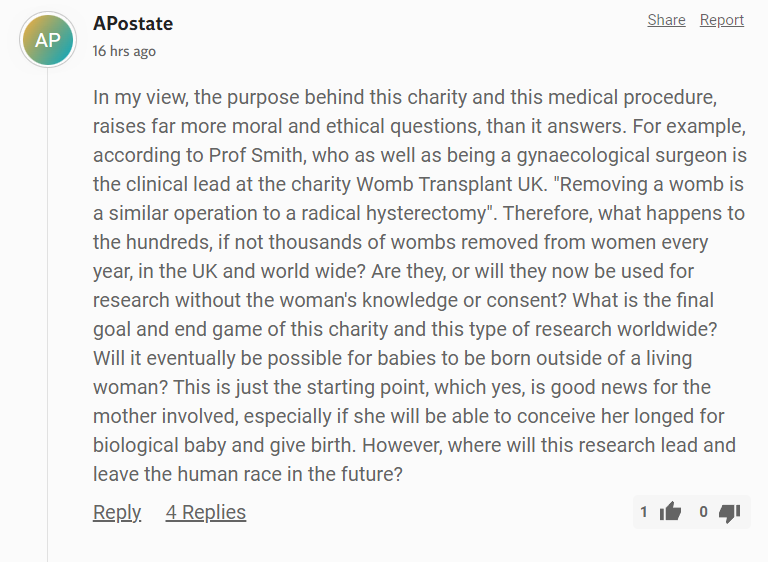
"In my view, the purpose behind this charity and this medical procedure, raises far more moral and ethical questions, than it answers. For example, according to Prof Smith, who as well as being a gynaecological surgeon is the clinical lead at the charity Womb Transplant UK. "Removing a womb is a similar operation to a radical hysterectomy". Therefore, what happens to the hundreds, if not thousands of wombs removed from women every year, in the UK and world wide? Are they, or will they now be used for research without the woman's knowledge or consent? What is the final goal and end game of this charity and this type of research worldwide? Will it eventually be possible for babies to be born outside of a living woman? This is just the starting point, which yes, is good news for the mother involved, especially if she will be able to conceive her longed for biological baby and give birth. However, where will this research lead and leave the human race in the future?"
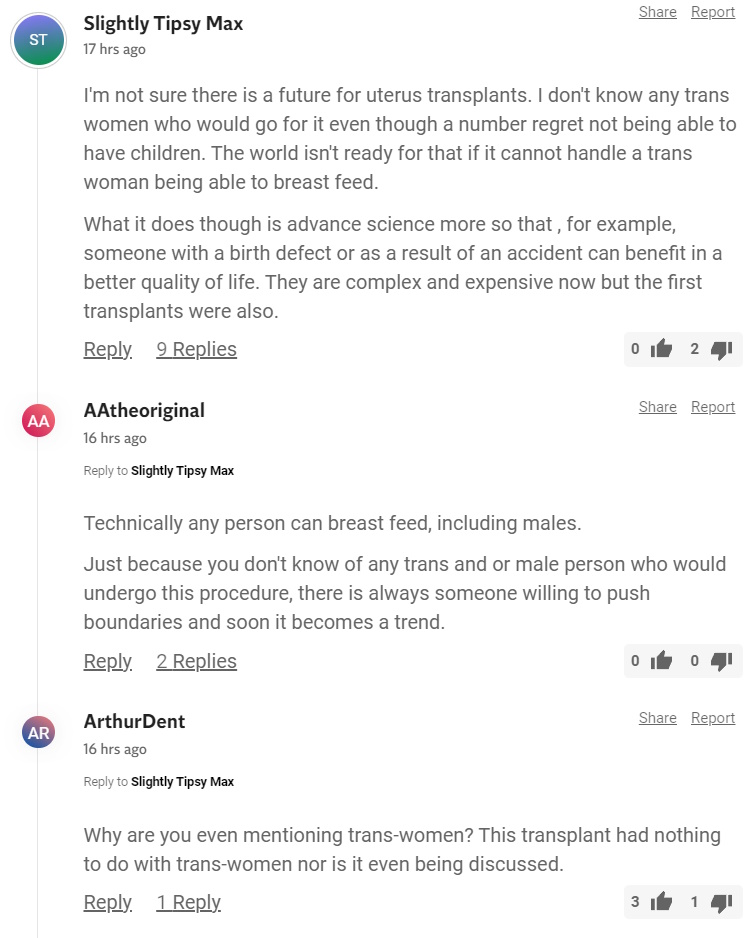
I'm not sure there is a future for uterus transplants. I don't know any trans women who would go for it even though a number regret not being able to have children. The world isn't ready for that if it cannot handle a trans woman being able to breast feed.
What it does though is advance science more so that , for example, someone with a birth defect or as a result of an accident can benefit in a better quality of life. They are complex and expensive now but the first transplants were also.
Technically any person can breast feed, including males.
Just because you don't know of any trans and or male person who would undergo this procedure, there is always someone willing to push boundaries and soon it becomes a trend.
Why are you even mentioning trans-women? This transplant had nothing to do with trans-women nor is it even being discussed.
Bonus content:


