As a professional in the art of handymannery, composite boards don't need pilot holes or anything. It does help to use the right screw though, that being
these. They're available in multiple colors to match your choice of deckboard and have a cutting tip that moves enough material away in the wood that you're mounting to so that you don't have to worry about splitting and have a smaller head than typical deck screws for treated lumber with the head having the opposite shape of a normal screw. The heads burrow into the composite and lock both the composite and the screw in place, they work really well. I've never known one to come loose or rust through, between the composite and the shape of the head they wedge together so perfectly that water can't get in between the composite and the screw, and the hex drive head is a lot less prone to being damaged than the Phillips heads that the screws he used are so the finish stays intact and thus won't rust either.
I will give Pat the benefit of the doubt and say that he did it himself. I base this on three things:
One, the boards are miscut by a not insignificant margin, I'd estimate by 1/8" to 3/16" each. He took the photo from the side where he lined them up evenly, but if you look at the opposite edge they're visibly off.
Two, as mentioned above and for the reasons stated, the choice of screw, not to mention that several of them were driven at angles that were off by as much as 15-25 degrees, depending on the length of screw that he used, I'll guess 3" and 15 degrees, which I will expound upon in my third point. If you look at them you can see that some edges of the heads are flush while the opposite edge is sticking up. When you're working with wood sometimes the grain of the wood just doesn't want to let you drive a screw straight but in composite there's no grain so it's very easy to drive the screws straight so long as it's something you've had a bit of practice with (and you're not drunk at the time)
Finally, I don't think anyone who does this for a living would have been willing to do this without replacing the existing treated lumber. It's not gone yet but, based on what's visible, it's at the point where it's time to consider replacing it before someone gets hurt. It's definitely not going to last the thirty years that the composite will, or even the ten years that fresh wooden steps would. I'll give it another year or two before issues begin to present themselves. The state of the wood also informs my logic on his choice of screw, that being that 1 5/8" to 2 1/2" screws likely weren't getting enough bite to hold them solidly in place. It's also why he left them a bit proud rather than just overdriving them which would be preferable to leaving them proud, there just wasn't enough meat left in the wood for the screws to pull themselves down any further (if you're screwing into good wood the screws will pull themselves all the way through the deck boards if you want them to). This spot right here is the tell-tale sign.
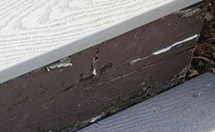
When those cracks start forming that's the wood letting you know that it's no longer structurally whole. It can still feel perfectly fine but as I've learned over the years you can stomp on a spot like that with all your might to see if it needs replaced and it won't give the tiniest little bit, so just as you think it's fine and walk over it it will give out like it's not even there (especially in Pat's case, though fresh wood may not be enough to prevent this in his situation either)
Just as a final thought, paint isn't the best choice for a deck. Even if that's the look that you want you'd want to go with a solid body stain. It just sticks to treated lumber better than paint does and subsequently holds up to the abuse that walking on it and kicking the kickboards places upon it. It also needs bleached and pressure washed prior to that, the algae/mildew/existing peeling stain/paint that's present will prevent proper adhesion. It also would have been easier to do that prior to replacing the deckboards. You can stain some composite decking so that may be his intent, but basically every composite deck I've worked on/seen has been left untreated as a contrast to the the stained lumber. I'm not saying I've never seen stained composite but I've probably worked on more houses than the average person has seen the inside of and I can't think of a single example in my decades of doing what I do.


