Używasz przestarzałej przeglądarki. Może ona nieprawidłowo wyświetlać tę lub inne strony. Powinieneś zaktualizować przeglądarkę lub użyć alternatywnej przeglądarki.
UKSainsbury’s ditches brown eggs in net zero drive - Supermarket says shift will ‘indirectly reduce demand on land and water used to grow feed crops’
Hannah Boland
Retail Editor
Published 03 June 2026 7:44pm BST
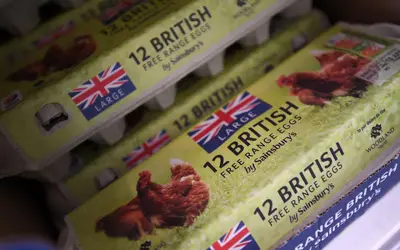
Sainsbury’s is ditching brown eggs and switching to white as it races to hit net zero.
The UK’s second-largest supermarket plans to sell only white-shell eggs in its own-brand cartons after studies found they have a lower carbon footprint than brown alternatives.
Sainsbury’s said the shift towards “lower carbon” eggs would help it hit ambitious targets to reach net zero within its own operations by 2035 and across all of its suppliers by 2050.
White eggs have a 12.7pc smaller carbon footprint than brown alternatives, Sainsbury’s said, because the hens that lay them tend to be smaller and consume less energy-intensive feed. The supermarket said this helps to “indirectly reduce demand on land and water used to grow feed crops, as well as the amount of manure produced”.
The retailer said the shift to white-shell eggs for its own-brand ranges would also help improve animal welfare across its supply chain, given the hens that lay them are less prone to feather pecking. In its latest annual report, the supermarket said it was “making progress” on the egg change.
The switch will see Sainsbury’s go back to the 1970s, when most eggs on Britain’s shelves were white.
Brown eggs became more prevalent after customers started to believe they were healthier and contained more nutrients. At the time, it was falsely claimed that white eggs had been bleached.
Up until relatively recently, brown eggs accounted for almost all the eggs sold in British supermarkets. The majority of white-shelled eggs – produced by breeds including the White Leghorn, which originated in Italy – have gone into restaurants rather than being sold directly to customers.
British supermarkets have started testing demand for white-shelled varieties in recent years. During the pandemic, Tesco began selling them after lockdown panic buying led to a shortage of brown alternatives.
Brown eggs tend to be larger than white eggs – given they typically are laid by larger hens – although there are few other inherent differences, with nuances such as how crackable shells are instead coming down to the age of hens and which breed they come from.
White eggs are more commonly seen in the US, where they account for three quarters of all that are consumed.
While shoppers have been happy to buy white eggs, Sainsbury’s may struggle to ramp up supply.
Sainsbury’s said the shift to white-shell eggs for its own-brand ranges would also help improve animal welfare across its supply chain Credit: Andy Rain/Shutterstock
Farmers have switched in recent decades to breeds of hens that lay brown speckled eggs to meet soaring demand from shoppers. White-egg-laying hens account for only 15pc of the national flock, according to the British Egg Industry Council.
A Sainsbury’s spokesman said: “White eggs have the same delicious taste and nutritional benefits as their brown counterparts, but result in lower emissions and better welfare outcomes for the hens that lay them.
“We know Brits love their eggs and, as we work with suppliers to transition all our own brand to white shells, they can now enjoy them knowing they are better for the environment and the hens.”
The drive by Sainsbury’s to phase out brown eggs is the latest example of changes to products to help it hit net-zero goals.
The supermarket began to vacuum pack its minced beef in 2023, rather than use plastic trays, to cut its use of plastic.
It was forced to defend the decision after shoppers claimed the change turned meat to mush. Sainsbury’s still vacuum-packs its mince today, and other retailers have followed suit.
Sainsbury’s said in 2023 that it had started culling cattle for beef, months earlier than usual, to help reduce its carbon emissions.
The egg color depends on the breed of chicken. Apparently, most of the world has just stuck with the chickens they always used, but any farm could choose to switch to the white egg breed.
Many US chickens are the white shell breed, not because of the shell color, but because they require less feed and start producing eggs sooner, so they are apparently slightly more cost effective.
I guess it lowers the carbon footprint because they eat a bit less per egg.
I grew up in a part of the US that mostly seemed to favor the brown shell chickens, unless it was Easter. I would imagine if they were shipping them from far off it would increase the cost, so they will probably just try to get their local suppliers to switch breeds.
Sainsbury’s said the shift towards “lower carbon” eggs would help it hit ambitious targets to reach net zero within its own operations by 2035 and across all of its suppliers by 2050.
They are mostly pale now. But a lot of urban people don't have access to farm fresh eggs or space to keep hens. I'm just glad I got a carton yesterday for $1.25.
My instinct is that a chicken that eats less is going to produce less nutritious eggs. I've no certainty on that, it just feels like it would. White eggs come from chickens that start laying sooner and more frequently, right? I want eggs with some investment, thanks.
Also, it's weird opening a carton and seeing these pale, American-style eggs. I don't like it.
They have this look of fakeness to them, it's off-putting. I've also read that white eggs are more fragile but I'm not too sure on the legitimacy of that considering I've never actually handled white eggs before, only brown.
Anyway, while I am normally viciously against any and all change, the actual meat of this change is largely fine to me. I worked on a chicken farm, they had leghorns (huwhite) and Sussex (brown) breeds. The leghorns start a little earlier, and they eat a little less for the same rough size of egg. Tastes the same, nutritionally they are pretty much the same. Brown eggs have a slightly rougher and tougher shell, but really so long as you feed your hens right, the eggs will be fine. In my experience the Sussex breed gets bigger, but that's just from one farm. Sainsburies should be punished and mocked for sucking Ed Milibands cock though.
My instinct is that a chicken that eats less is going to produce less nutritious eggs. I've no certainty on that, it just feels like it would. White eggs come from chickens that start laying sooner and more frequently, right? I want eggs with some investment, thanks.
Also, it's weird opening a carton and seeing these pale, American-style eggs. I don't like it.
I suppose they might just be a little smaller, the birds themselves, that is. Less calories wasted on upkeep of the bird. They seem to have weaker shells and less colorful yolks, but that is probably because they are the breed favored by the extra-cruelty mass producers. A white egg pastured chicken eating bugs and other forage should be compared to the brown ones.
I think shell strength is also tied to age of the chicken in some way. Basically though, focusing on cost reduction per egg is going to cut the quality down more than the breed of chicken.
It is, older hens lay thinner shelled eggs. Shell gland production in the uterus gets weaker, she can't get as much calcium from her diet, the egg can get bigger without a corresponding increase in calcium. Don't worry though, older chickens still have their use! She's going off with grandad to his farm, which has no chickens...
They have this look of fakeness to them, it's off-putting. I've also read that white eggs are more fragile but I'm not too sure on the legitimacy of that considering I've never actually handled white eggs before, only brown.
They're definitely easier to crack than brown eggs, but then again where I am white eggs are usually from battery hens and cheaper while brown come from cage free and free range, so it could just be the difference in grit and oyster shell etc supplement that they're given
My instinct is that a chicken that eats less is going to produce less nutritious eggs. I've no certainty on that, it just feels like it would. White eggs come from chickens that start laying sooner and more frequently, right? I want eggs with some investment, thanks.
They do. Smaller, less nutritious, and they don't lay as long, so you need more hens for the same number of eggs. The carbon bullshit is just that: bullshit. Marketing that they believe will let them charge more per egg.
So they’re cheaper and have a higher profit margin and this can be used to make money while greenwashing the reason. Nice.
Yeah the white shells are thinner. Best eggs come from happy backyard chicks so if you can find someone who sells locally, do that, they will be so much better than any shop bought you can get. My parents get theirs off a neighbour who had an allotment and they’re like an entirely different thing to even a supermarket organic fancy egg. Bright orange yolks, taste fantastic